In board games, pictures and symbols can be used for a range of reasons: artwork, of course, but they are usually also providing a lot of information that would otherwise not fit on a card, board or game component.
Visually impaired too need to get access to this information. Here is where tactile drawings and graphics come into place.
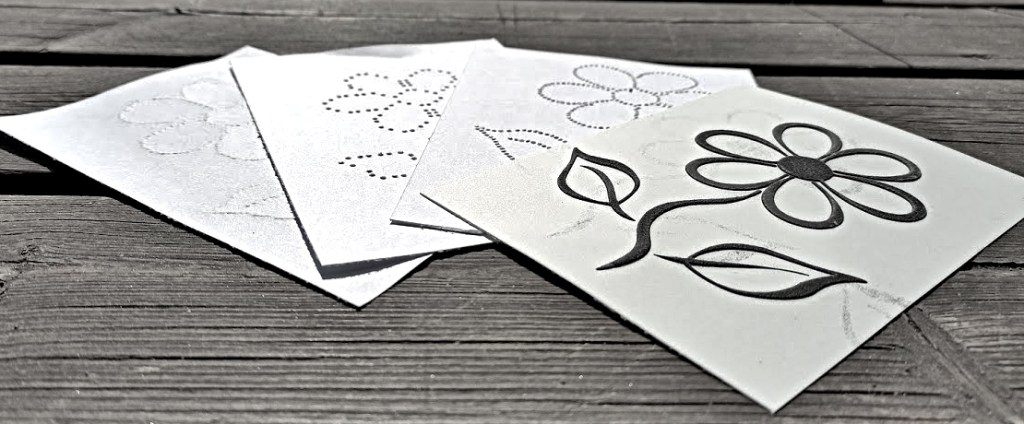
On this picture are four tactile drawings of a flower. They are sorted by increasing need of specialized equipment.
Left: freehand with a raised line drawing board

This drawing is traced manually on basic paper using a raised line drawing board.
Such board allows to create raised drawings with a regular pen or stylus and paper. It is inexpensive and can be used for maps, children’s drawings, geometry, and diagrams for instance. It is very easy to use: put a paper on your board and start drawing with a pen or a stylus. Once finished, you can turn your paper around and feel the rasied picture you just drawn in tactile form.
Note that the image will be reversed!
I bought my board from the Braille Superstore http://www.braillebookstore.com/Raised–Line-Drawing-Board.1
Next: Drawing using braille
Braille characters are formed by using a combination of 6 raised dots. Each combination forms a braille cell. Braille cells represent letters, symbols, but also a lot more like music, math, chess or even knitting patterns.
So, why not use them for what they physically are too, dots that can be combined to form raised patterns? Be sure to inform the reader that he or she is supposed to look at a pattern and not read a text though, as it can otherwise be quite disconcerting!
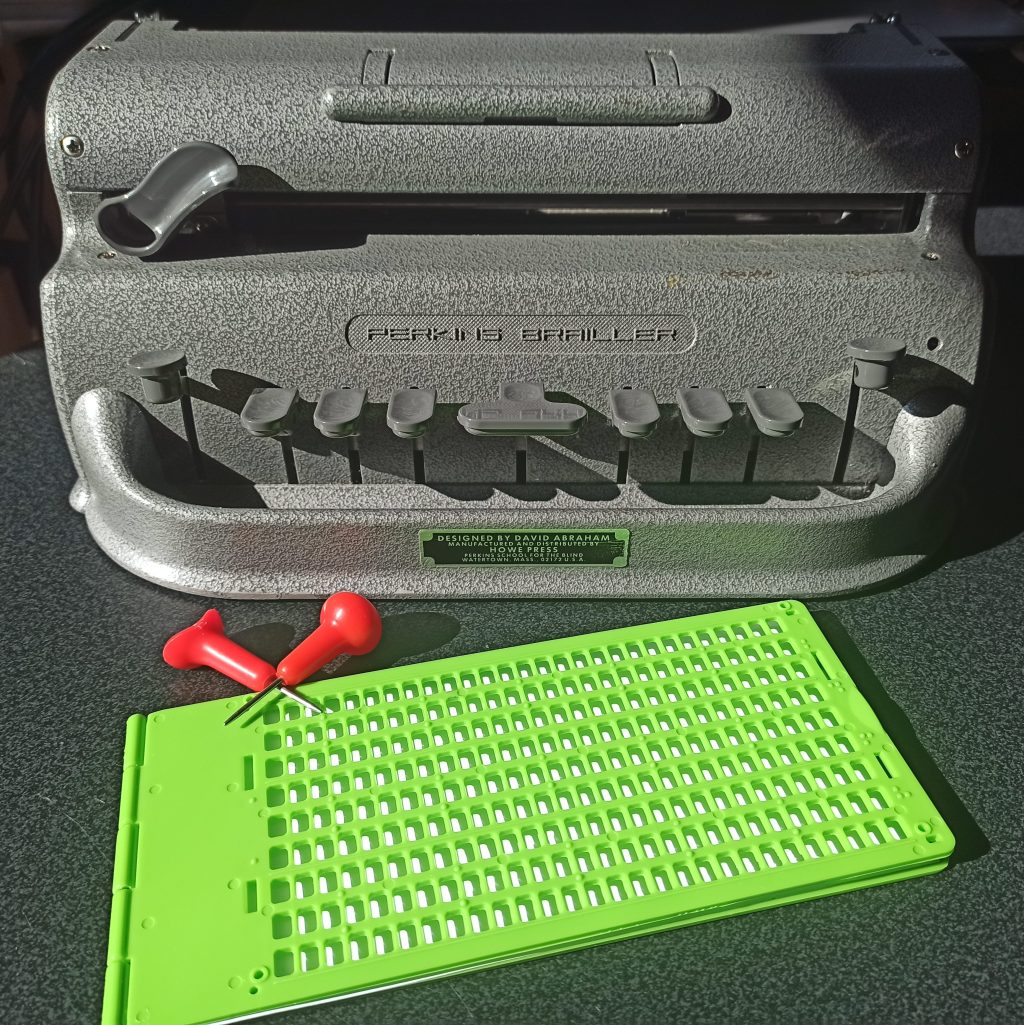
Braille can be written using a slate and stylus (inexpensive but slow, green and red in the picture), a braille typewriter (the grey device) or a braille embosser, the braille version of a printer.
Here is in text what is used for the first line of the flower in Unified English Braille: 3 emply spaces, in, c, enough, empty space, in, c, enough.
And here is the same line read by a finnish braille user: 3 empty spaces, *, c, ?, empty space, *, c, ?
Yes, you guessed it: a single symbol in braille can indeed have a different signification in different languages! More on the subject in a future post.
Third image: random raised dots
Braille cells have very specific sizes: the dot spacing within a cell is between 2.3 and 2.5 mm (both vertically and horizontally), the cell to cell spacing in a line is 6.0 to 6.2 mm and 10,0 mm between rows. This means that drawing a smooth line or a curve is basically impossible.
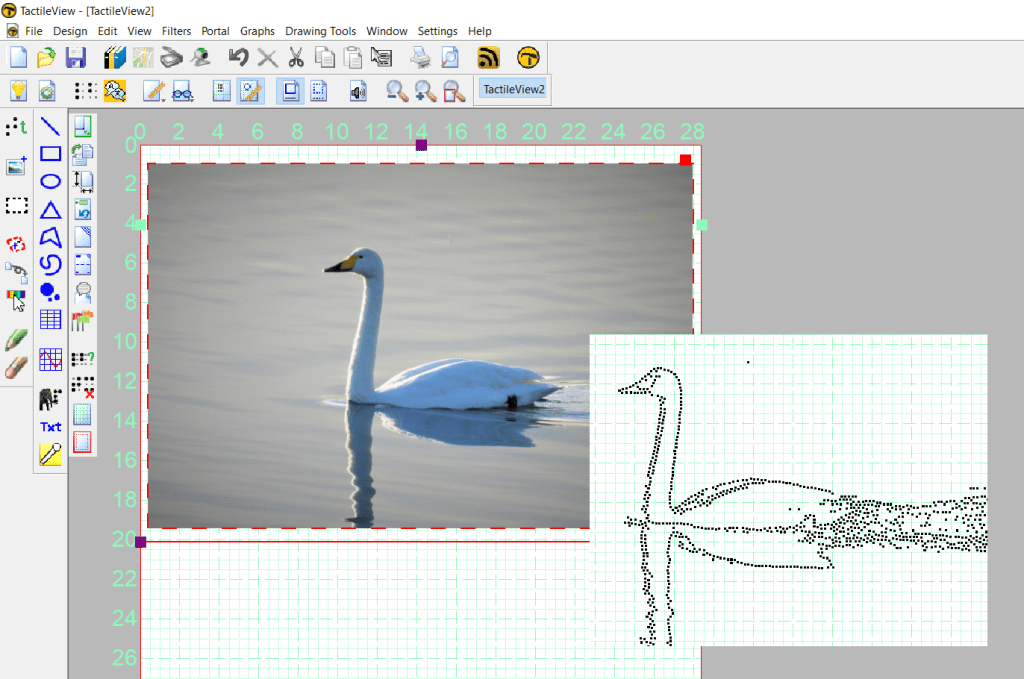
Using a computer program and an embosser that allows it, however, it is possible to convert all line drawings into regularly spaced alignments of dots, leading to much smoother shapes.
I used TactileView to create the flower and my Everest DV5 to emboss it.
More on TactileView at https://www.tactileview.com
More on the Index embossers at https://www.indexbraille.com
Right: capsule paper
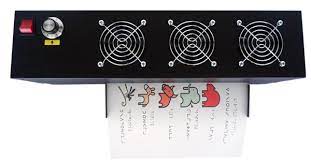
This is the only drawing using ink. The drawing was printed on special capsule paper and sent through a Zychem swell form machine. Once submitted to the heat of the swell form machine, the carbon-based inks swell and create a tactile version of all the black lines and areas on the paper.
More on the Zychem Swell form machine at https://zychemltd.com/swell-form-tactile-graphics-machine
 fiksufox.com
Jätä kommentti